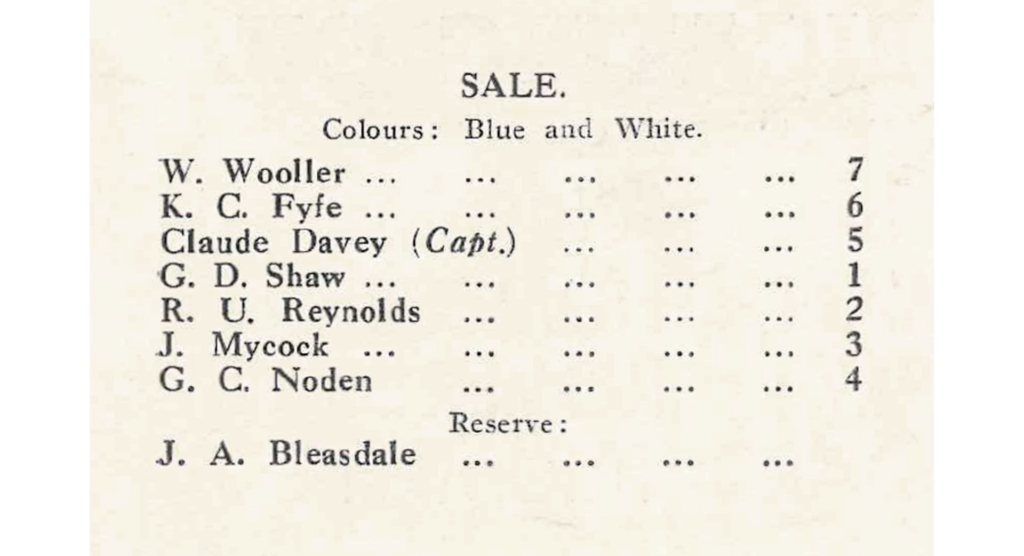

7. Wilf Wooller
Wilf Wooller followed his cousin in playing for Sale during the 1932/33 season whilst still a pupil at Rydal School, in North Wales. His talent saw him soon picked for Wales and between 1933 and 1939 he won 18 caps, playing a key role in his country’s first victory over New Zealand in 1935.
Wilf went on to Cambridge University and played cricket for Glamorgan, taking five wickets for 69 runs in the victory over the West Indies in 1939. When the Second World War broke out he joined up and whilst serving in Java, south-east Asia, he was captured and held captive for the rest of the war at the notorious Changi prison in Singapore.
After the war he resumed his cricketing career captained Glamorgan from 1947 until his retirement in 1960. In his later life Wilf became a prominent sports commentator, covering rugby and cricket for the Sunday Telegraph and commentating on cricket for BBC Wales. He was the commentator as Gary Sobers famously hit six sixes in one over at Swansea in 1968.

6. Ken C Fyfe
Ken Fyfe was born in Karachi – now Pakistan – to an English mother and a father who played football for Scotland.
He attended the University of Cambridge, where he won four rugby blues from 1932 to 1935. In the 1934 Varsity Match, he scored a hat-trick of tries, helping Cambridge secure a 29–4 victory over Oxford and marking the last such feat in the fixture until 2008. His standout performance drew the attention of Scotland selectors, leading to his appointment as national team captain for the season.
At club level, Fyfe played for Sale in the mid 1930s, forming part of a star-studded international backline alongside players like England’s Hal Sever and Wales stars Davey and Wooller. Ken, who also represented Preston Grasshoppers, was also an accomplished cricketer, representing the Europeans cricket team in India during the 1937/38 season.

5. Claude Davey – Captain
Welsh centre Claude Davey played for Sale from 1930-1936 and captained the team at the Middlesex Sevens.
A hard-tackling centre, Claude first came to notice while playing for the Wales Secondary Schools, before gaining a place in a Wales University XV, while he was studying electrical engineering at Swansea University.
Claude was known as one of the most outstanding Welsh players of his generation, winning his first cap against France in 1929. He went on to win 23 caps and captained his country on eight occasions. His most famous performance was on December 21st, 1935, when he led Wales to a historic 13–12 victory over the mighty All Blacks in Cardiff.

1. George Duncan Shaw
Like the Curry brothers, George Duncan Shaw was a product of Oundle School and captained the school rugby union side. A prop who was, unusually, known for his goal-kicking prowess, he moved to Sale from Scottish club Gala in 1934 as he was taking up a post in Staffordshire.
Shaw hit the headlines for the wrong reason on 25 May 1937 when the Staffordshire Sentinel reported that he was caught speeding by the police and was fined £3 by the court. Shaw had missed the train for an away match and was attempting to hurry and catch his Sale team-mates.
Shaw was capped by Scotland seven times. His first cap was against the All Blacks in 1935 and he continued representing Scotland until the Second World War.

2. Robert Uvedale Reynolds
Robert Uvedale Reynolds was a distinguished rugby union forward of the 1930s who made his name with Sale Football Club and the Cheshire county side. Known for his strength, determination, and reliability in the pack, Reynolds became one of the region’s most respected amateur players during the inter-war period.
His finest honour came in 1936 when he was selected to represent the combined North-West Counties XV against the touring New Zealand All Blacks. The prestigious fixture, played at Richmond’s Athletic Ground on 16 December 1936, was one of the standout matches of the era and showcased the best talent from Lancashire and Cheshire against the world’s leading rugby nation.
A loyal servant to both Sale and Cheshire, Reynolds’ career reflects the proud traditions of northern rugby and his place among the notable players of English rugby’s amateur age.

3. Joe Mycock – Captained Sale XV in 1936
Joe Mycock was born in Bakewell on January 17th, 1916, and educated at Giggleswick School, in Yorkshire. He played for Vale of Lune and captained Sale in 1936. Joe said one of his principal aims at Sale was to strengthen the junior teams and try to bring on the club’s own players. He joined Harlequins in December 1936.
Joe also played at lock for the Combined Services while serving in the RAF. In later life he followed a business career in South America, the Far East and Nigeria.
On the international scene, Joe was first selected for England in January 1939. He ended up winning five caps, captaining England in 1948. The same year, he played six games for the Barbarians included the match against Australia in 1948.

4. G. C. Noden
G. C. Noden was one of Sale Football Club’s most distinguished and versatile rugby union players, enjoying a career that spanned the 1930s and 1940s. Beginning as a skilful half-back, he later reinvented himself as a formidable prop, forming a powerful front-row partnership with Sale greats Jock Mycock and R. U. Reynolds.
His playing career was interrupted by the Second World War, during which he served with distinction as an army officer, attaining the rank of Lieutenant Colonel and enduring captivity as a prisoner of war.
Returning to civilian life, “Col. Noden” became a towering figure in North West rugby administration. He served as President of the Cheshire County Rugby Football Union and was a respected ambassador for the game, frequently invited to open new clubhouses and grounds across the region, reflecting the esteem in which he was held.